
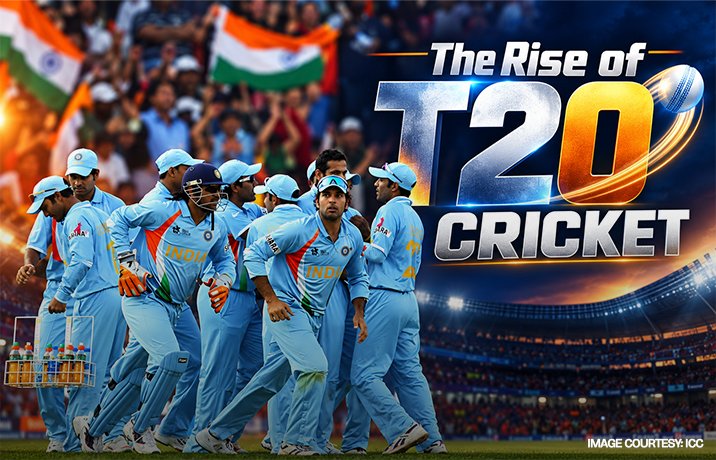
The Rise of T20 Cricket: How a Shorter Format Changed the Game Forever
Cricket has always been a game of skill, patience, and strategy. However, as the world became faster-paced, the sport needed a format that could deliver excitement in less time. Enter Twenty20 (T20) cricket — a revolutionary version of the game that transformed how cricket is played, watched, and experienced around the world.
From explosive batting and dramatic finishes to glamorous franchise leagues and global superstars, T20 cricket has redefined the modern game. What began as an experiment in England has grown into a global sporting phenomenon, attracting millions of fans and reshaping the commercial landscape of cricket.
The Birth of a Cricketing Revolution
T20 cricket officially emerged in England in 2003, introduced by the England and Wales Cricket Board (ECB) to revitalise domestic cricket and attract new audiences. Traditional formats often required spectators to commit an entire day or several days to a match, whereas T20 offered a complete contest in approximately three hours.
The concept proved an immediate success. Its combination of aggressive batting, clever bowling, and fast-paced action appealed to established cricket fans and newcomers alike.
The format reached a major turning point in 2007 with the inaugural ICC Men's T20 World Cup in South Africa. India's thrilling victory over Pakistan in the final captured the imagination of fans and demonstrated the format's enormous potential. Suddenly, T20 cricket was no longer just a domestic experiment — it had become a global spectacle.
Why Was T20 Cricket Introduced?
T20 cricket was introduced in England in 2003 by the England and Wales Cricket Board (ECB) to make domestic cricket more exciting, attract larger crowds, and appeal to a younger generation of fans. At the time, traditional county cricket was struggling to attract spectators, particularly to one-day competitions. The ECB wanted to create a shorter format that could deliver an entertaining cricket match in a single evening.
With each team playing a maximum of 20 overs, T20 cricket offered a faster alternative to traditional formats. The shorter duration made matches easier to fit into busy schedules, while aggressive batting, innovative shots, and dramatic finishes created an exciting experience for spectators. The format also opened up new commercial opportunities for broadcasters and sponsors.
The first official English domestic T20 competition took place in 2003, featuring 18 county teams. Its success encouraged other cricket boards to adopt the format, eventually leading to the inaugural ICC Men's T20 World Cup in South Africa in 2007. India won the tournament by defeating Pakistan in a thrilling final, helping T20 cricket gain enormous international popularity.
Today, T20 cricket has become a major part of the global game, inspiring successful franchise leagues such as the Indian Premier League (IPL) and the Big Bash League (BBL). What began as an effort to revive interest in domestic cricket has transformed into one of the sport's most commercially successful and widely followed formats.
A New Era of Aggression and Innovation
T20 cricket changed the way players approached the game. Batters began searching for boundaries from the opening overs, while bowlers developed an expanding arsenal of slower balls, deceptive variations, and precise yorkers.
Unconventional strokes, reverse sweeps, and innovative shots over the wicketkeeper's head became familiar sights. Captains also had to rethink field placements, bowling rotations, and tactical decisions, often making crucial choices within a matter of deliveries.
The influence extended beyond T20 cricket itself. One-day internationals became increasingly aggressive, and even Test cricket saw teams embrace faster scoring and more attacking strategies. T20 did not simply create a new format; it helped reshape cricket's wider playing philosophy.
Franchise Leagues: Cricket Becomes a Global Business
The launch of the Indian Premier League in 2008 marked another defining chapter in T20 history. By combining international stars, emerging talent, city-based teams, and high-profile entertainment, the IPL established a new model for professional cricket.
Its success inspired competitions around the world, including Australia's Big Bash League, Pakistan Super League, and the Caribbean Premier League. These tournaments created opportunities for players to compete alongside international stars, learn from different cricketing cultures, and reach wider audiences.
Franchise cricket also transformed the sport's commercial appeal. Broadcasting deals, sponsorships, ticket sales, and player auctions brought substantial investment into the game. For many cricketers, T20 leagues became valuable sources of income and career opportunities.
Beyond the financial rewards, these competitions gave young players a platform to showcase their abilities on a global stage. In many ways, franchise leagues became talent factories, helping develop the next generation of cricketing stars.