
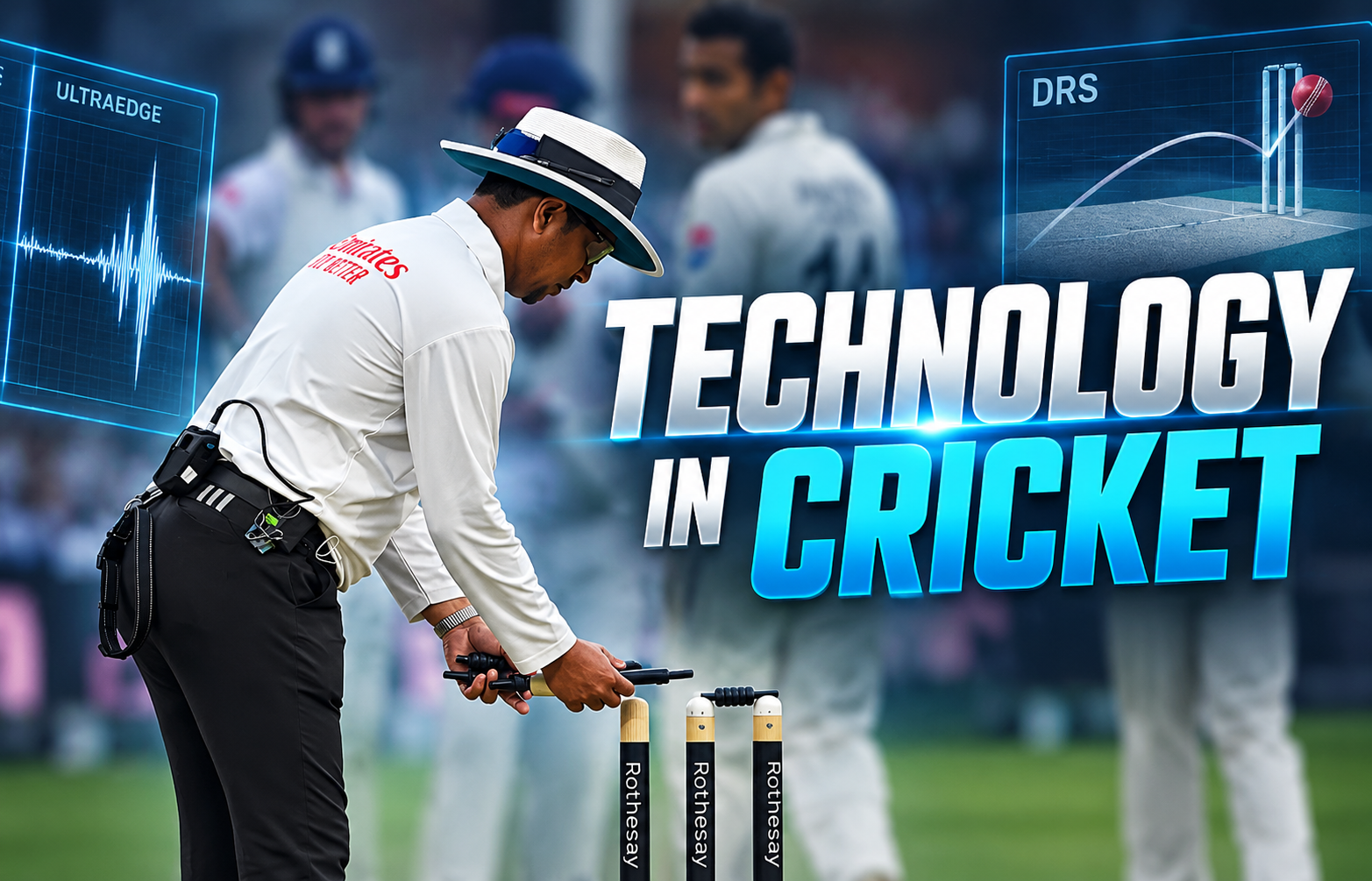
The Impact of Technology and Media on Cricket
Cricket, like many other sports, has undergone significant changes over the years. One of the most notable developments has been the increasing role of technology and media. These two forces have transformed how the game is played, watched, analysed and experienced. From advanced tools that help umpires make accurate decisions to performance-tracking systems that help players improve their skills, technology has become an essential part of modern cricket.

At the same time, television broadcasting, online streaming and social media have brought cricket closer to millions of fans worldwide. Features such as slow-motion replays, real-time statistics and interactive digital platforms have made the sport more engaging and accessible than ever before.
In this article, we explore the evolution of technology in cricket, the role of media in expanding its global reach, the influence of social media, and the latest innovations shaping player performance, decision-making and the future of the game.
1. Evolution of Technology in Cricket
Cricket has experienced a remarkable technological transformation. In the past, umpires relied primarily on their eyesight and judgment to make decisions. Today, advanced camera systems, audio technology and computer software provide additional evidence to support decision-making.

Hawk-Eye: Tracking the Ball
Hawk-Eye is one of the most important technologies used in modern cricket. It uses multiple high-speed cameras to track the ball's movement and reconstruct its trajectory. The system can show where the ball pitched, where it struck the batter and where it would have travelled.
Hawk-Eye is particularly useful for reviewing leg-before-wicket (LBW) decisions. When a batter is struck on the pads, the system helps determine whether the ball would have hit the stumps. It also provides visual representations of bowling lines, lengths and ball movement, helping viewers and coaches understand the game more clearly.

UltraEdge and Snickometer: Detecting Edges
UltraEdge and Snickometer are technologies used to help identify possible contact between the ball and the bat. They analyse audio signals captured by sensitive microphones and synchronise them with video footage.
When the ball makes contact with the bat, the sound may produce a noticeable spike on the audio waveform. By examining whether the sound occurred at the moment of suspected contact, officials can assess whether a batter edged the ball.These technologies are particularly valuable when reviewing caught-behind decisions, where the ball travels towards the wicketkeeper after possibly touching the bat.

Hot Spot: Detecting Contact Through Thermal Imaging
Hot Spot uses infrared thermal-imaging cameras to detect temperature patterns caused by friction when the ball contacts a surface. The resulting images may reveal a mark where the ball has touched the bat, pad or other equipment.
This technology can provide additional evidence when determining whether contact occurred. However, the absence of a visible mark does not necessarily prove that there was no contact, so the evidence must be interpreted alongside other available information.
Decision Review System (DRS)
The Decision Review System, commonly known as DRS, allows teams to challenge certain on-field umpiring decisions according to the competition's playing conditions.
DRS combines technologies such as ball tracking, UltraEdge and other available video evidence to help the third umpire reassess decisions. It is not a single piece of equipment but a review process involving several technologies and officials.
DRS is used for decisions such as LBW and caught-behind dismissals, as well as certain boundary and run-out incidents. It has significantly improved the review process by giving officials access to evidence that may be difficult to assess with the naked eye alone.
Stump Microphones
Stump microphones are small audio devices installed in or around the stumps. They capture sounds from the pitch, including bat-ball contact, the ball hitting the stumps and players communicating during a match.
Their audio can help support edge-detection reviews when synchronised with video footage. They also improve television coverage by allowing viewers to hear the sounds of the game, making broadcasts more immersive.
Together, these technologies have made modern cricket decision-making more evidence-based, although their accuracy and use depend on the system, the available evidence and the applicable playing conditions.
2. How Media Revolutionised Cricket Coverage
Media has played a major role in bringing cricket to audiences around the world. The development of television broadcasting, satellite communication and internet streaming has transformed how fans follow matches.

Satellite Television and Digital Broadcasting
Satellite television helped cricket reach audiences far beyond the countries where matches were played. Broadcasters such as ESPN and Star Sports brought international tournaments, bilateral series and domestic competitions into millions of homes.
Modern broadcasting also relies on fibre-optic networks, internet streaming and digital distribution platforms. These services allow fans to watch live matches on televisions, computers, tablets and smartphones.
Online streaming has introduced additional features, including on-demand highlights, alternative camera angles and interactive match statistics. As a result, viewers have greater flexibility in deciding when, where and how they watch cricket.
SpiderCam: Aerial Views of the Game
SpiderCam is a remotely controlled camera system suspended by cables above the playing area. Its motors allow the camera to move horizontally and vertically, capturing dynamic views of the pitch and stadium.
It provides aerial perspectives of bowling run-ups, fielding positions, celebrations and important moments during a match. These moving camera angles give viewers a better understanding of the action and make television coverage more visually engaging.
Slow-Motion and High-Speed Cameras
High-speed cameras capture footage at a higher frame rate than standard video cameras. When the footage is played back at a normal frame rate, the action appears in slow motion.
This technology helps viewers examine fast-moving events, such as bat-ball contact, close catches, bowling actions and boundary incidents. Slow-motion replays can reveal details that are difficult to see in real time.
However, slow-motion footage is not automatically conclusive proof of an incident. Officials must consider the relevant evidence and playing conditions when making formal decisions.

On-Screen Graphics and Real-Time Statistics
Modern cricket broadcasts use specialised graphics software to display scores, run rates, wickets, required targets, player statistics and other match information.
Visual tools such as wagon wheels show where a batter has scored runs around the ground, while pitch maps illustrate where a bowler has delivered the ball. Ball-speed graphics and performance comparisons provide additional insight into individual performances.
These features help viewers understand tactics and statistics without needing to interpret complex data themselves.
3. Technology's Influence on Player Performance
Technology has changed how cricketers train, prepare for matches and manage their physical condition. Modern players increasingly combine traditional coaching with sports science, video analysis and data-driven performance assessment.
Fitness Trackers and GPS Technology
Wearable fitness trackers and GPS devices help monitor player movement, speed, acceleration and training workload. Some devices can also measure heart rate and other physiological indicators.
Coaches use this information to understand how much physical effort a player is undertaking during training and matches. For fast bowlers, workload monitoring can be particularly useful when managing fatigue and planning recovery periods.
GPS tracking can also help analyse fielding movement and running patterns. Although these tools can support injury-risk management, they cannot guarantee that injuries will be prevented.
Biomechanical Analysis
Biomechanical analysis examines how the human body moves during sporting activities. It uses high-speed cameras, motion-capture systems and specialised sensors to study movements such as a bowler's delivery action or a batter's swing.
Coaches and sports scientists can use these observations to identify technical inefficiencies, improve balance and evaluate movement patterns that may place excessive strain on the body.
For example, analysing a fast bowler's run-up, delivery stride and arm movement can help coaches understand the mechanics of the bowling action and make informed adjustments to training.
Smart Bats and Motion Sensors
Smart-bat technology uses small sensors attached to a bat or its handle to measure aspects of batting technique. Depending on the device, these sensors can estimate bat speed, swing angle, bat path and impact timing.
Players can use this information to compare different shots and identify areas for improvement. A batter, for example, may analyse the swing speed and bat path of a cover drive to understand how changes in technique affect performance.
These systems are mainly used for training and technical analysis. They complement coaching rather than replacing the experience and judgment of coaches.

Data Analytics and Performance Software
Data analytics has become an important part of modern cricket strategy. Performance software processes ball-by-ball records, video footage and player statistics to identify patterns in batting, bowling and fielding.
Coaches can study a batter's performance against different types of deliveries, examine a bowler's most effective lines and lengths, and assess how players perform in different match situations.
For example, historical data may show that a batter struggles against short-pitched bowling directed towards a particular area. A team can use this information to develop a bowling plan and choose appropriate field placements.
Analytics can also assist with batting-order decisions, bowling changes and opposition analysis. However, statistics must be considered alongside pitch conditions, match circumstances and individual player form.
4. The Role of Social Media in Shaping Modern Cricket
Social media has brought players, teams and fans closer together. Platforms such as Instagram, YouTube and X allow cricketers to share training routines, personal experiences, match updates and behind-the-scenes content.
Fans can react to performances in real time, participate in discussions, create memes and share highlights. This interaction has transformed cricket from a sport primarily consumed through television and newspapers into a continuous digital conversation.
Social media has also become an important promotional platform for cricket boards, broadcasters, sponsors and players. Teams can announce selections, share exclusive videos and connect directly with supporters.
However, the rapid spread of information also creates challenges. Unverified reports, misleading clips and online abuse can influence public opinion before the facts are established. Responsible communication and reliable reporting remain important in the digital cricket environment.
5. Artificial Intelligence and the Future of Cricket Analytics
Artificial intelligence (AI) is creating new opportunities to analyse cricket data and automate certain tasks. AI-powered systems can process large datasets, recognise patterns in video footage and support performance analysis.
Potential applications include identifying batting weaknesses, studying bowling strategies, generating match highlights and assisting with statistical summaries. Computer vision, a field of AI, can also help software recognise and track players and the ball in video footage.
For example, an AI-assisted analysis system could examine previous deliveries to help a coaching team understand which bowling plans have been effective against a particular batter.
AI may also improve automated camera operations, player tracking and broadcast production. However, its predictions remain estimates rather than guarantees, and human expertise continues to play an important role in interpreting results and making decisions.
6. Augmented Reality and Virtual Reality in Cricket
Emerging technologies such as augmented reality (AR) and virtual reality (VR) could make cricket training and viewing experiences more interactive.
Augmented Reality (AR)
Augmented reality overlays computer-generated information onto a real-world view. In cricket broadcasts, AR can be used to display digital graphics that explain ball trajectories, field placements and player statistics.
For example, an AR graphic could illustrate a delivery's projected trajectory during an analysis segment or show a virtual field placement alongside live match footage.
These visualisations can help viewers understand technical aspects of the game more easily.
Virtual Reality (VR)
Virtual reality uses headsets and computer-generated environments to create immersive experiences. In cricket, VR can be used in training simulations that allow batters to practise reacting to virtual bowlers and different types of deliveries.
It could also enable fans to experience simulated views from the batter's crease or explore virtual stadium environments.
VR can supplement traditional training and entertainment, although the benefits depend on the quality of the simulation and the skills being practised.
7. The Importance of 5G Technology in Cricket
5G is a mobile network technology designed to provide high data rates, greater network capacity and potentially lower latency. It can support the delivery of high-quality video and interactive digital content, particularly in connected stadium environments.
For cricket fans, 5G may improve access to live streaming, match statistics and multiple video feeds on mobile devices. Broadcasters and stadium operators may also use connected networks to support cameras and other digital systems.
For example, spectators could watch a replay on their phones while attending a match, provided the network and streaming service support that feature.
However, 5G is a connectivity technology rather than an umpiring or performance-analysis system. Its contribution is primarily in helping data and media move efficiently between connected devices and services.
8. Other Digital Technologies Supporting Modern Cricket
Several additional technologies contribute to the way cricket is played, analysed and presented.
Video analysis software: Coaches use video tools to replay, annotate and compare batting shots, bowling actions and fielding movements. This helps players understand their technique and track progress over time.
Ball-speed measurement: Camera-based or radar-based systems estimate the speed of a delivery. These measurements provide useful information for broadcasters, coaches and spectators.
Electronic scoreboards: Digital scoreboards display scores, overs, wickets, targets and other match information inside stadiums. They allow spectators to follow the game even when they cannot see the broadcast screens.
Cloud computing: Cloud services can store, process and distribute large volumes of match footage, statistics and digital content. They support workflows used by broadcasters, analysts and online platforms.
Computer vision: This technology enables software to identify and track objects in video, including players and the ball. It can support automated highlights, player tracking and broadcast graphics.
These systems often work together with cameras, statistical databases and broadcasting networks to create a connected digital cricket experience.
9. How Technology and Media Work Together
The different technologies used in cricket serve distinct but complementary purposes.
Cameras and sensors capture match footage, player movements and ball trajectories. Analytical systems process this information to support umpiring reviews, performance assessment and tactical planning. Broadcasting systems then present relevant footage, graphics and statistics to viewers.
For instance, during an LBW review, ball-tracking technology may help assess the delivery's trajectory, while the third umpire considers the available evidence under the applicable review procedure. At the same time, broadcast graphics can explain the decision to viewers.
Away from the field, fitness trackers and performance software help coaches evaluate training, while social media and streaming platforms allow fans to follow the match and discuss key moments.
This combination of technologies has made cricket more measurable, accessible and interactive without removing the importance of human skill, judgment and strategy.
10. The Future of Cricket in the Digital Age
The future of cricket is likely to involve even closer integration between sports science, data analytics, broadcasting and digital experiences.
AI may provide more sophisticated performance insights, while AR could make tactical explanations easier to understand. VR may offer more immersive training environments, and improved connectivity could deliver richer viewing experiences to fans around the world.
Wearable devices and video analysis may also continue to help players understand their physical workload and technical performance. Meanwhile, broadcasters will look for new ways to combine live action, statistics and interactive content.
These developments will also raise important questions about data privacy, technology costs, access to equipment and the balance between innovation and the traditional character of the game.
Ultimately, technology should support cricket rather than overshadow it. The excitement of a last-over finish, the skill of a great batter, the precision of a fast bowler and the judgment of an experienced umpire will remain central to the sport.
Conclusion
Technology and media have fundamentally transformed cricket. Hawk-Eye, UltraEdge, Hot Spot and DRS have improved the process of reviewing important decisions, while fitness trackers, biomechanical analysis, smart bats and data analytics have changed how players train and prepare.
At the same time, satellite television, SpiderCam, slow-motion replays, real-time graphics and online streaming have made cricket more accessible and engaging for audiences worldwide. Social media has strengthened the connection between players and fans, while AI, AR, VR and 5G offer further opportunities for innovation.
As these technologies continue to develop, cricket will become increasingly data-driven and digitally connected. Yet its lasting appeal will continue to come from the competition, unpredictability, teamwork and unforgettable moments that make the sport special.