
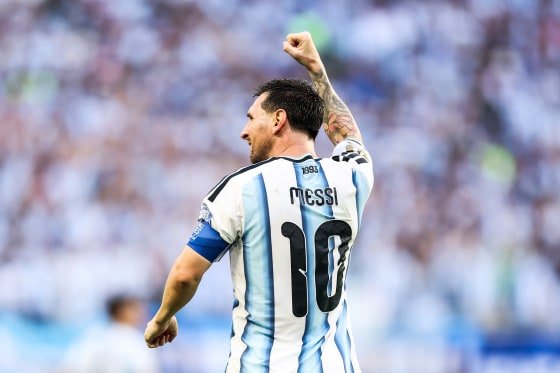
Lionel Messi has finally said goodbye to Argentina.
At 39, after more than two decades of carrying the hopes, expectations and dreams of an entire football nation, Messi has announced his retirement from international football.
The decision comes weeks after Argentina's heartbreaking 1-0 defeat to Spain in the 2026 FIFA World Cup final. Messi had led his country to yet another World Cup final, but the chance to lift the trophy for a second time slipped away.
For Messi, however, the decision was not made overnight.
In an emotional message shared on social media, the Argentine captain revealed that he had already written his farewell shortly after the World Cup final. The death of his father, Jorge Messi, in August only made him more certain that it was time to close this chapter.
“I gave everything I had, and I don't have anything more to give.”
Those words perhaps explain Messi's decision better than any statistic ever could.
From Argentina's biggest question mark to its greatest hero
Messi's relationship with the Argentina national team was not always a fairytale.
For years, his brilliance with Barcelona created an impossible standard. Every time Argentina lost, the question was the same: could Messi win something with his country?
He came agonisingly close.
Argentina lost the 2014 World Cup final to Germany. Two years later came another painful Copa América final defeat to Chile. After the 2016 loss, Messi even announced his retirement from international football before eventually changing his mind.
Then everything changed.
In 2021, Messi finally lifted his first major senior international trophy when Argentina defeated Brazil in the Copa América final.
A year later came the moment that completed his story.
Qatar 2022 changed everything
The 2022 FIFA World Cup in Qatar was supposed to be Messi's final attempt at winning the trophy that had eluded him throughout his career.
Instead, it became the defining chapter of his legacy.
Messi scored seven goals during the tournament, including two in an unforgettable final against France. Argentina eventually won on penalties, giving Messi the World Cup trophy he had chased for so long.
The victory also changed the conversation around Messi in Argentina.
The comparisons with Diego Maradona became less about who was greater and more about two legends who had taken Argentina to football's highest peak in different eras.
Messi had finally done it.
And he wasn't finished.
Argentina won the 2024 Copa América, making Messi part of a golden generation that turned years of disappointment into an era of dominance.
One final World Cup
There was no guarantee Messi would play at the 2026 World Cup.
At 39, questions about his fitness and longevity had become impossible to ignore. Messi himself had previously said that his participation would depend on how his body felt.
But he made it to the tournament.
And once again, he mattered.
Argentina reached the final, where Spain eventually won 1-0. It wasn't the fairytale ending many fans had imagined for Messi, but his final World Cup still added another remarkable chapter to his story.
Messi leaves the Argentina national team as its record appearance-maker and record goalscorer, with 207 international appearances and 125 goals. He represented Argentina across six World Cups and won the 2022 World Cup, two Copa América titles and Olympic gold during his international career.
This is not the end of Messi's football career
There is an important distinction in Messi's announcement.
He has not retired from professional football.
Messi will continue playing for Inter Miami in Major League Soccer. The club extended his contract through the end of the 2028 MLS season, meaning fans could still have several more seasons to watch the Argentine superstar in club football.
That means the No. 10 isn't disappearing from football just yet.
But the Argentina shirt will now belong to someone else.
And perhaps that is what makes this goodbye so emotional.
The end of an era
Messi's international career was never simply about goals and trophies.
It was about pressure.
It was about expectations.
It was about losing finals and being questioned for years before finally winning everything that Argentina supporters dreamed of.
He went from being the player blamed for Argentina's failures to becoming the captain who helped deliver the country's greatest successes in decades.
And now, he has chosen to walk away.
Not because he has nothing left to offer football, but because he believes there is a new generation ready to take Argentina forward.
Messi's final message to his country made that clear. He spoke about the young players coming through and said he would now support the national team from the outside.
For 21 years, Argentina watched Messi play for them.
Now, for the first time, they will have to watch without him.
The little boy from Rosario who once dreamed of wearing the Argentina shirt has fulfilled that dream in almost every possible way.
He leaves as a World Cup champion, a two-time Copa América winner, Argentina's all-time leading scorer and appearance-maker, and one of the most influential footballers the sport has ever seen.
The final chapter with Argentina didn't end with another trophy.
It ended with something perhaps more fitting for Messi's story — gratitude, emotion and the knowledge that he gave everything.
Leo Messi is no longer Argentina's No. 10.
But he will always be one of the biggest reasons that number became immortal